Showing posts with label Reviews. Show all posts

Monday, July 4, 2011

Book Review: Hawks at a Distance

Book Review time!
(required disclaimer:  Princeton graciously provided a copy for this review!)

Hawks at a Distance
By: Jerry Liguori
Price on the back cover: $19.95
~190 pages
~29 species


The Skinny: It's a superb book that teaches you to ID hawks from GISS (general impression size shape), and not just field marks, and it's only ~$20 so it's 100% a great buy. The extended version below:
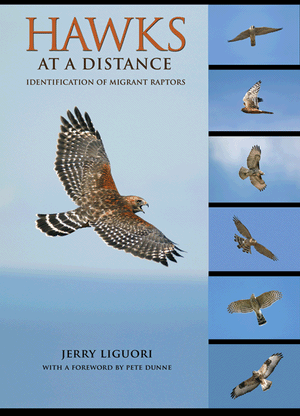

Well the book starts off right with a spectacular topside shot of a Red-shouldered Hawk. Doesn't get much better than that, does it? I'm not sure what they've done in the printing process, but it really is spectacularly sharp... And just looks great... As a photographer, it doesn't start any better than this.

Breaking down the guide, it's organised as one would expect: 

Foreward
How to use the book
general AnatomyTips/hawkwatching etc
Species accounts
A fun section on "shapes" (more later) 
and credits/biblo


Sounds like a pretty generic field guide, right? Well, yes it sounds like it, but it isn't! 

Jerry is one of the best hawkwatchers ever. (Yes, ever). Hawkwatching is definitely one of the most unique/stand alone/different (couldn't choose a word) aspects of birding. (Don't believe me? Go to a hawkwatch and talk to the people who never even look at "dickey birds") ... Anyways... Jerry isn't one of those people, but is a master at the unique craft of hawkwatching... And now, in his two recent books (Hawks from every angle, and this one) he has done a great job in providing a teaching tool to pass along the things he's learned.

Hawkwatching often involves trying to identify migrant raptors passing a specific location at every height and behaviour. Sometimes, you'll have birds several kilometer's up, so they just appear as tiny spec's. Rather than use visual marks, sometimes you must rely on GISS (general impression size shape) and behavioural clues if you're going to have any hope of an ID! 

Anyways, before I ramble too much ... Have a look for yourself at some sample pages and you'll see where I'm goin with this:


Right away you can tell that they aren't frame-filling detail photos, and you're going to be learning about factor X of hawkwatching (I just made that name up). 

Now I'm sure some of you are saying "But Brandon, I don't want to identify hawks that are 8km's away".. And I'll say "but you don't have to!" Learning the skills provided in this book aren't only applicable to tiny microspecs, but will improve your ID of flying raptors in any situations. It's like going into battle with multiple weapons.. Or if you're the peaceful type (Hi Jenn!) It's like going to an ice cream shop that has several extra flavours. You'll just get better and better at getting those hawks. I might even stretch it far enough to say you'll then learn how to apply those skills to other families of birds on your own (I do it with fall warblers all the time). 


For ~$20 the book is absolutely a steal. Most of the specie accounts start off with a spectacular full frame photo, that is a recent trend in field guides I really like... The book ends off with a neat series of pages on "shapes" - focusing on each of the main species with dozens and dozens of small images. I won't go into too much detail (build suspense?) but you'll have to take a look for yourself if you see the book on the shelves! 


Who should buy it: if you spend time at hawkwatches, I'd say you MUST get it. If you are a "general birder", i'd still highly recommend it. 

Who shouldn't: buy it: Similar to my last review, I'd say this isn't a "first time" birder book. If you'd call yourself a "beginner birder", then yes, it's a good book. Just don't buy it for your young cousin who's never been birding in his life. 


Biggest concern: Although I love everything about the book, I wish there was a bit more attention to Mississippi Kites. Jerry did a neat thing here where he made a section in the last pages for "Uncommon Migrants and Others" - which is great - but I don't think Mississippi Kite should have been included here. It occurs in hawkwatches as far north as Duluth and Whitefish Point! (Along with most in Ontario/NY etc) .... It deserves more!


So there you have it..  Hawks at a Distance! Similar to last time, I'll update the post if there's anything else that comes to light after I publish this!


Sunday, June 26, 2011

The beginning of the end? Or the beginning of the book reviews?

The Crossley ID Guide: Eastern Birds
Listed on the book at $35.00 USD
~530 pages (640 species?)
~10,000 photos used
Size: Huge


Thanks to a sweet deal with Princeton Publishing, I now have a free copy of the Crossley ID guide, which I can relay my feelings towards you!

At first, I didn’t like it... Which I’ve learned over the years means it’s probably going to be something I end up liking... And I did! I was worried it was “too much”, with 10’000 bird images loaded into a massive book. If you don’t want to read any further, here’s the skinny:

I don't think it's going to "change birding as we know it", but:

It’s a worthwhile book for any birder. Birders are known to add lots of books to their collection, and in that sense, this book is a MUST. Heck, it’s probably a much better stand-alone field guide than dozens of other books on the market. But since most of us have “collections”, there’s no doubt what so ever that it’s worth adding (for a really good price...)

Anyways, here’s some more of my thoughts, expanded:  


Who should buy it:  in this case, it’s easier to say who shouldn't buy it! I see various groups of people who can use the book:

Casual birders: can find more of what they’re looking for in this book than any other photo field guide out there. I can’t imagine trying to use other photo-field guides that have a single image per species to identify birds. (Eg,/ how can you identify a Black-bellied Plover in its gray non-breeding plumage with only a photo of a breeding plumaged bird? They’re nothing alike!) It is a very useful addition to their collection.

Intermediate birders: can use the book largely to the same degree. I’m sure we all reach a point where there is only so much inside a book that we can learn from, but clearly this book has more to glean from than any other.

Even for the most advanced birders, this book has a surprising amount of things to pull from it. There is no one who can argue that having 10000+ images of birds couldn’t be put to good use, but I found myself already searching through for things I could find amongst the masses of images. I noticed the female Orchard Oriole (big image, listed as female) is actually a fall juvenile bird (notice the Juvenal-gape showing). Or how some “breeding plumaged” shorebirds are shown in fresh plumage (April/May) or worn fall migrants (July/August) under the same label. I’m sure there is a lot more I’ll turn up as I search through more of the collections.


Who shouldn’t buy it: anyone who is thinking of just starting as a birdwatcher. I can’t imagine buying this book for a friend who has never been out birding once before. It might scare them  away. It is a limited case where buying a pocket-sized illustrated field guide would probably be a better way to go!


Overly critical: Baird’s Sandpiper is front/centre a Juvenile, White-rumped Sandpiper is a spring adult. It would be nice to have some sort of theme to how the birds are placed (eg/ adult breeding plumage always in the bottom right) – but this probably wasn’t realistic to the author!

Also,

Biggest critique: remove distracting background elements from some of the photos! Not really a big deal at all, but some strange things like the huge wreckage in the background of the Bonaparte’s Gull image. Why not just open water for more open water birds? Or “beach birds” on a plain beach? (eg,/ Bar-tailed Godwit has people in bathing suits behind it)

(Not the best example, but this image could maybe have been stronger without the boats? I dunno...)


Things someone like me would notice:

Ad. Male Hornemanns’ Hoary Redpoll isn’t an Ad. Male

Griseus SBDO is not fully in breeding plumage

The adult Red-necked Stint is a worn adult in breeding plumage (eg,/ July/August) like the vagrants we see in North America, while Little stint is "spring breeding plumage" (eg,/ early May) seen in Europe? It doesn't really show the observer what a Little Stint would look like in North America... 

Some birds (Thayer’s/Iceland – are really good). And I mean really really good considering how troublesome groups of birds like this are, never mind explaining it in a field guide.....

(ICGU/THGU page)


Anything else?

I’ve heard a lot of mixed reviews of the book, but I’d guess it’s more peoples surprise at how “new” this style of field guide is. (afraid of change?) No, I don’t think it’s going to change the birding world, but yes, it’s a superb addition to a collection!


Check out the Crossley website for more info if you're curious:


------------------------------


So yeah! That's my quick review of the book. I'll update the blog if I have more time to search through it and find anything new. It's the first time I've reviewed a book, so please feel free to critique my review! I'd like to know what you think!