Thursday, May 19, 2016

Pelee Island, May 6-17th, 2016


Fish Point - wrecked by storms in 2015... 


Had a ball at Pelee Island from the 6th to 17th of May... Overall, it wasn't the most memorable for "weather" (the source of all good birding or general enjoyment of the outdoors) - but it was freakin PELEE ISLAND - so of course an excellent time was had by all.

Possibly most notable were some of the things we DIDN'T see:

E. Fox Snake
Blue-spotted/Smallmouth Salamander
Blue Racer (ok, I guess some of these are to be expected)...
Gray Fox
Most butterflies
Most ducks
Many "semi-expected" rarities or even "rare/uncommon" birds. (eg,/ missed all southern overshoots, Cerulean, White-eyed Vireo, Clay-coloured Sparrow etc etc etc)


In fact, the bird checklist for the entire trip topped out at ~155 species... A nice total, but I also had 150 species IN A DAY in May 2014, without trying to max-out on species... Just a little context I guess...


Lake Erie Water Snake


Huge Red(?) Mul Berry 


Some highlights:

Select #'s of migrant butterflies (ladies, admirals)
Black Saddlebags (1)
Map Turtle
Blanding's Turtles
Lake Erie Watersnakes (sev)
"Melanistic" Gartersnakes (sev)
Brownsnakes

Botany was great/fun - but I don't know enough to say what they all were - but lots of great plants/trees....

7 American Avocets
Willets
White Pelicans on 4-5 different days (including one from our cottage)
2-3 observations of Neotropic Cormorant
1 "possible/distant" Pacific Loon
1-2-3 observations of possible Black-capped X Carolina Chickadee hybrids (photos to come).
26 Warbler species
1 Dickcissel
Thayer's & Lesser Black-backed Gulls
Whimbrel (2 days, first three on May 12th)
A presumed "Florida" Bald Eagle

"Southern" Baldie 

Cott Age Will Ets

Avochets

Mini-corm


One thing we did really quite well with was some very memorable birds/birding/moments - with May 11th standing out as being particularly insane. We casually birded Fish Point (only) throughout the day, and ended up with HUGE numbers and excellent looks at the neotropic migrants (est 2000+ warblers, 60+ Scarlet Tanagers, 200+ Kingbirds etc). Other days had some really great days/views/encounters with obscene numbers of Blue Jays, cooperative shorebirds, Swallow congregations etc. Even managed a dash of photography here and there...

So yeah! Overall, not the most action-packed rarity/busy/intense May of birding I've ever seen, but thankfully we had an A+ time --- keeping the excitement alive for 2017 where hopefully the weather is a bit warmer and more variety and big days occur!

Insane-o-jays!


I'll probably pull another blog post or three out of some additional Pelee pics/events. Stay tuned. Or don't. Doesn't really matter. 

Thursday, May 5, 2016

PEAK of May Birding Forecast


No one has any idea... NONE! But i'll guess anyways....

---

We've been under the influence of a number of short wave troughs, semi-regular blocking patterns, an upper low to our NE and even some cutoff-looking lows... It's chaos in the weather world - and not totally in the "good" kinda way. Each small feature influences all of the other small features around it - and therefore affects how subsequent features in the days to come will be affecting or affected by all of the other small features... This is why the forecast is always changing and each model run is different from the next. Slight variations in the timing, intensity, direction etc have a compounding effect on the events that follow. Crazy!


Above and below - same time - GFS vs Euro.. One says "yeah, it'll be warm and good for migraiton" - the other says "yeah, it'll probably be a pretty cold morning. Good luck" 


The common theme with these model runs seems to be regular intrusions of cold air into the southern Great Lakes... So here's my birding guess:


--- Any day now, we're going to see an influx of migrants that contains the more "northerly" breeders. In spring, they want to go north... I'm a bit worried that large numbers of boreal breeding songbirds will take a more "westerly" route - away from Lake Erie - and we'll "miss" a lot of birds - but some will still fly overhead...

--- When they finally arrive, if they hit regular waves of cool/cold air and precip - they'll be grounded... Hopefully on the right side of the Lake (hard to say though, recent waves seem to be pushing them back to Ohio)...

--- Sporadic warm air seems to *not* be coming in from the due south so far - but more of a WSW to W flow. What does this mean? Well normally I'd expect to see birds coming from SE Texas or the gulf coast - even the SE states - when warm blasts come racing in.... With a WSW to W direction - maybe we'll get some vagrants from places we aren't used to seeing as often? The "vagrant weather" doesn't look amazing in the model runs, but it does only take "one bird" as they say... And I perhaps this is how it will play out, as we've clearly seen a few vagrants in Ontario already this spring that are are NOT used to hearing about...


6-10 day temp forecast/guess


8-14 day temp forecast/guess


SO, in summary:

I'm hoping/guessing there will be several very enjoyable days of birding - with decent drops of migrants, perhaps many low and close if the weather gets cool - and an ever changing/roller coaster ride of weather that should keep things fresh on a daily basis - and hopefully with a few fun vagrants mixed in to keep us on our toes. My hopes are high for a very fun few weeks of May birding!!!


(and we'll see how the later-in-May weather is looking in 7-10 days as we get closer to that time)


8-14 day rain forecast (looks very similar to the 6-10 day)... Not what we normally see this time of year.. Freakin El nino. 


Oh - and for the record - the models/forecasts are saying SATURDAY and TUESDAY could be the next migration waves/pulses/surges (!!!)


Wednesday, May 4, 2016

Grace's Warbler Weather


Something obscene happened at the tip of Point Pelee today. I'm not even going to mention it (but congrats to those who saw it!!!). I'm going to do, what I do best - guess about the weather!


While the weather has been really weird recently - but nothing really stands out. Above is the surface map around the time of the observation... There's a really odd little LOW right around Pelee - which probably helped get birds up and moving... 

BUT

I don't think the weather played major part in the DETECTION of this bird... 

---

Given the huge number of birders at Point Pelee - and the regular rarity observations - I used to think it was a prime location to study the effects of the weather on bringing vagrant birds to an area. After years of struggling to understand everything - I learned I was WRONG!

Point Pelee - as a geographic feature - is positioned perfectly positioned to capture birds that are moving SOUTH. That's why it see's regular and spectacular concentrations of birds in the FALL... On top of that, as a point - it also concentrates birds from a relatively large area into a space that a single observer could monitor (the tip)... So what does this have to do with the Grace's Warbler? (I said I wasn't going to talk about it)... 

Well I would bet at least 3 chicken's that this bird was within 50-100km of Point Pelee yesterday... I'd bet another chicken that it was somewhere NORTH of the tip... Could be inside the park, undetected... Could be Lake St. Clair.. Could be the Bruce Peninsula - but I'd bet those 4 Chickens that it was ALREADY horribly lost, long before it made it's presence known this morning... 

Why? It's the primary reason why Point Pelee is a BAD place to study the effects of weather on vagrant birds... The weather today had nothing to do with it's detection (imo).. It just wandered around (potentially moving back south) and the "southbound concentration effect" of the points geography brought it to the tip of Point Pelee. 

BAM! What a CRAAZY bird. Very fitting for Point Pelee as well (being a warbler). 

Here's a few images from the night/morning:


Above - 850mb winds - not at all interesting... 

Below: migration from the night before. Some birds were moving!


Phudge. 

Tuesday, May 3, 2016

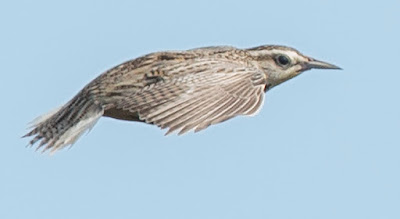
What (I think) I've learned about Meadowlarks

http://www.blog.peregrineprints.com/2016/04/meadowlarks-impossible-identification.html

We don't know everything.

Boom.

---


Anyways, here's a breakdown of what (I think) are the KEY features of the Meadowlark we had at Pelee on 25 April 2016, based on a variety of resources and commentary from a handful of experts.

(Visual only)

Eastern Meadowlark is the darkest. Has dark centres of the tertials and centre tail feathers. White malar. Rufous or warmer colour tones. Intermediate and variable white on the outer tailfeathers (45-55% white). Crown stripes are dark-black. Eyeline wider on average. Undertail coverts normally streaked. Sides typically "streaked".

Western Meadowlark is pale. Tertials and centre tail feathers are pale with dark barring. Malar has at least some yellow MOST of the time, but not always. Colder/paler tones overall lacking rufous. White on tail variable but mostly (always?) a "dark tail" with a bit of white on the sides (40-50% white). Crown stripes brownish. Eyeline thinner on average. Undertail coverts normally streaked. Sides typically have a more "spotted" look (more oval shaped markings).

"Lilian's" Eastern Meadowlark is pale. Tertials and centre tail feathers are pale with dark barring. Malar white. Colder/paler tones overall lacking rufous. Extensive white on the tail (a white tail with a dark centre stripe - or 55-60% white). Crown stripes brownish to dark(ish)-blackish. Eyeline intermediate (?). Undertail coverts normally have limited markings. Sides typically have streaks - possibly less on average than "Eastern".


SO - I'd say it breaks down to this:

Eastern Meadowlark has an overall pattern of dark markings & rufous that is unlike Western or Lilian's, which show an overall paler plumage. To that end, Lilian's should be different from Western by showing limited markings on the sides - and (maybe) the undertail markings - and especially by the amount of white in the tail feathers. Lilian's has the MOST white in the tail while Western has the least. Should be clear cut, right?


Well - apparently it's not. Here are my thoughts:


The overall dramatic "paleness" to this bird should rule out "Eastern". The head stripes, eye stripe etc. are not blackish, there is no rufous/rich colour anywhere... 


And if that doesn't quite do it for you, I think the tail and tertial patterns should eliminate "Eastern". It essentially has pale feathers with thin dark bars. So while these aren't the only reasons, what i've read and heard should eliminate "Eastern" - leaving Western and Lilian's to consider. 


An area where Lilian's apparently differs from both Eastern and Western is the streaking on the undertail coverts - it is minimal at best, where the other two should have obvious/numerous marks... This bird is minimal at best, matching Lilians. 


Something I haven't noted yet. Meadowlarks have 12 tail feathers (6 on each side). I never expected to have to worry about it, so I didn't get a *definitive* shot showing all the feathers (I took what I could get on one pass, then left the bird alone)... 


With these feathers we can focus on what should be the most obvious feature between Western and Lilian's.. The amount of white in the tail feathers... Bear with me - but I think this makes sense. In each of the above photos - the pink text shows four dark centre tail feathers - and no photo really makes me think it has more than that...

Using a combination of photos, I think we can confidently say the bird has at least three white tail feathers on its right side (thanks to the first photo - green lines) and 2-3 are visible on the left side (lower photo).

If you're good at math (like me) you'll realize that we're two feather short - which is why I noted above that I failed to get the definitive shot... BUT - in the above photos - I think we can say the bird has a lot of white in the tail.... Not only that but the feathers visible in the second photo on the left side (yellow marks0 show a few tail feathers that are TOTALLY white at the tip. As far as I can tell, even the Western Meadowlarks with an abnormally high amount of white in the tail - show dark markings near the tips of the white feathers. (Like this bird here). (or this one). 


So as far as I can tell, this bird checks off all the boxes (visually) for "Lilian's" Eastern Meadowlark. It would have been nice to hear it call, but it didn't. I would be interested to hear if anything on this bird doesn't line up with this identification, or if I have anything wrong in terms of field marks. It just shouldn't be here. 


Likewise, IF this bird were not a "Lilian's" Meadowlark, it would break a few established marks in separating the following species. 


"Eastern" Eastern Meadowlark - IF it were this subspecies, it would mean that our regular birds can show a very pale plumage as normally associated with Western or Lilians. This wouldn't only include paler markings on the crown/eyeline/back - but a fundamental difference in pattern on the tail, tertials etc. 


Western Meadowlark - IF it were this species, it would mean that several "breakable" rules were broken, such as no yellow on the malar or more "streaky" and less "spotted" marks on the side, Another rule that could be broken (but books say shouldn't be) is the near lack of markings on the undertail coverts. I've found a few photos of birds lightly marked here - but the vast majority are nothing like this bird. Finally, if my tail-feather analysis holds water; that this bird has a lot of white - then this bird would be an EXTREME tail pattern for Western. I just cannot find Western Meadowlark tails that have pure white tips on any single tail feathers. 


So there you have it. My thoughts, in text form. In this instance, it brings me peace of mind to know that I have these photos - and as our knowledge increases - I can look back and recall these stills at anytime (or anyone else for that matter). I will be particularly interested to see if anyone either knows - or learns - that first-year Meadowlarks show more white/less markings - or if they typically show less white/more markings than adults. I think that'll be a VERY telling piece of information (if it's useful - perhaps it wouldn't be). Pretty much everything deals with adults - and 90% males.

So there we go! Now I can get back to more interesting things - like the weather.


As always - thoughts/comments are appreciated!

Sunday, May 1, 2016

On a scale of Easy to OMFG


I've contemplated this many times, and have never been able to follow through with any kind of analysis. It's just too darn complex! So, what is it?


Active birders are much more likely to find cryptic rarities than obvious rarities. 


There. I said it. And i'm not talking "slightly more likely". I mean "WAAY more likely". Why? Two reasons. 


1. The number of "records" a bird has for a given region, isn't representative of it's actual occurrence. 

A few years ago a Brown Pelican showed up on Lake Erie. The darn thing was observed FOUR times from Point Pelee, Rondeau, Long Point and Buffalo in a matter of days. Why? It's a freaking obvious bird. That's why. 

If a Neotropic Cormorant shows up on Lake Erie, the thing could circle the lake for weeks on end before it was observed. Why? It's a boring and non-descript bird. That's' why. 


2. Active birders are more likely to recognize a cryptic rarity. 

The more you bird a given area, the more familiar you are with the locals, and the more likely you are to recognize something that is out of place. I started "birding" at my local hawkwatch. I spent years hoping to see a Black Vulture, but it just never happened. Countless people focused on the field marks required for an ID... Under primaries whitish. Short tail. etc. Then I went to South Carolina and saw my first Black Vulture - and I identified it from 7km away as a spec on the horizon. Why? I'd studied 25,000 Turkey Vultures in detail waiting for a Black. I knew them so well, that the "real deal" (the would-be odd bird out) was soo freakin obvious it hurt. 

If I hadn't studied all of those Turkey Vultures, the unique appearance of the Black Vulture wouldn't be "obviously different". Context I say! 


Some (personal) case studies:

I've came across SIX Neotropic Cormorants in Ontario to date. Yes, it's a recent phenomenon... But I would be willing to bet that every single Canadian record of NECO was found by someone who had previously found a "rare bird". Then there's Varied Thrush - a bird I would KILL to find while out birding. I can't help but think I may never stumble across one  - yet it's considered a "regular rarity". Why? 

Neotropic Cormorants are ugly and non-descript rarities that spend time on large bodies of water. 

Varied Thrush are beautiful and obvious rarities that visit backyard bird feeders. 

Result:

The number of records of each is not a true representation of the species occurrence. Half of Ontario's NECO records have been found by 3-4 people. There aren't many people who have come across more than 1 VATH. If NECO's were hot pink and liked to eat french fries, there would be a LOT more records. 


Some other species to consider: 

- Fork-tailed Flycatcher, Scissor-tailed Flycatcher, Brown Pelican, Black-bellied Whistling Duck, Wood Stork, Glossy Ibis, Swallow-tailed Kite, Black Simmer, Brambling, Painted Bunting - all probably get noticed pretty regularly and the total number of records probably indicates how often they occur in Ontario. 

- Yellow-crowned Night-Heron, Black Rail, Little Stint, Long-tailed Jaeger, Common Poorwill, Dusky Flycatcher, Violet-green Swallow, Sprague's Pipit, Smith's Longspur, Baird's Sparrow, - all probably end up in Ontario far more often than the number of records suggest, but for various reasons go unnoticed or unidentified. 


Likewise, the rarities that DO occur in Ontario may be more likely to be dull and indescript than you'd think. 

A high percentage of the records for the following species are adults or (specifically) adult males: Lazuli Bunting, Tufted Duck, Hooded Oriole, Cinnamon Teal, Slaty-backed Gull, Black-headed Grosbeak, Little Stint, Lark Bunting, Common Teal - If we could readily recognize the females, young or non-breeding plumages of some species, there would be more records. 


Finally, and this is especially true at a place like Point Pelee - but the more time you spend looking, birding, recording - you're only likely to observe MORE of these challenging birds... If you double your time spend birding/observing/recording... I would guess that the odds of stumbling upon something stunning like a Roseate Spoonbill increases relative to your effort. Whereas doubling your effort on cryptic birds would quadruple the observations you have. Why? 

- The "further" you can identify birds (eg,/ lakewatch, hawkwatch) - the amount of "area" you can search increases quite a bit - therefore you see more birds in total, and more rarities. But here's the catch - you only see further/distant/crappier birds! So the "rarities" one sees are not the most "enjoyable" occurrences. They were right in front of you all along. 

- The "faster" you can identify birds leads to more ID's and less "missed" birds. Which equals more observations of unsuual birds. But here's the catch - it's more observations of brief half-second encounters...

- Birds fly. (Fact). In my experience you see a higher total number of birds in flight than you do on the ground. Therefore, if you spend a lot of time identifying birds in flight, you see an equal increase in rarities. But here's the catch - they're flying, and then they're gone. 90-95% of the time, they're gone. There's no point-blank Black-necked Stilt to swoon over. It flew away. 

- The more you bird around heavily birded areas, the more the "point blank beauties" get spotted, reported and twitched before you ever arrive. So you end up recognizing that cryptic rarity that has been lurking around in plan sight. But here's the catch - IT'S CRYPTIC. If it were a Painted Redstart, you would have twitched it yesterday. 


So what's the point of all this? Well I personally think that there is no better way to bird - than exactly how you want to bird. Looking for rarities suits my style of wanting to identify every single bird that I see, no matter what the context. It's a challenge, and it's fun!

To those of you who say 'you can't identify everything, you've got to let them go" - I say - BOO - I don't care...

But what I will also say, which has no bearing on this recent Meadowlark thing (honest - #nothonest) - is it too much to ask for a G@WD D@MN MALE PAINTED BUNTING?!

:) 

Bird on!


Tuesday, April 26, 2016

Meadowlarks: Impossible Identification?


Can anyone even identify these things?

Point Pelee - April 25th - Serengeti Tree

I feel a little too close to this thing to bother trying to dive into the ID, so instead I send out the challenge to someone more skilled to put a name on it. Obviously I didn't take all these photos because I was hopeful it was an Eastern mind you... Looked quite pale. Didn't vocalize. Not able to say either way... It could be a Lilian's for all I know...

So?! What is it?!


Added a few more: