Tuesday, July 12, 2011

B-side ducks from Newfoundland

(Went away for a few days. For now, I give you some filler!)


Some of my last Newfoundland photos, these images were ones I pulled out when I finally finished sorting the 20,000 photos I took on the trip!


(I really like this one)


Saturday, July 9, 2011

Feeeelings


(Palm Warbler)


Oh birds flying out over water... How much fun you are... Standing at the tip of Fish Point, Team Burrell and us (Dad, Jenn) were enjoying a reverse migration when the ever exciting Merlin arrived on the scene and began terrorizing the waterbound birds:


The bird moved so darn fast, I couldn't get shots in focus, but it gives you an idea of the events that unfolded this day:


How could you not be excited by this? We all watched on excitedly as the Merlin missed a few captures, and eventually took some sort of Warbler to the promise land...

>>>>>>>>>> FAST FORWARD >>>>>>>>>>

Suddenly it's 10 days later at Point Pelee, it rained overnight, and it's very cold. Birds are soaked and crawling around on the ground, many near death. We can't help but feel bad for the little buggers. 


You're a freezing Yellow-billed Cuckoo, right at the tip of Pelee. Fly south to the promise land? Must have seemed like a good idea at the time:

(note, I BLEW these photos, this is the best I have though) :


Flying out over the water, the cold cuckoo looked odd enough to attract the attention of the gulls. From there on out, it's textbook:


There's one difference however... Instead of being excited for the Merlin, we're watching in horror... If I had "Green-Lantern" style powers, I'd probably make up some sort of weapon and blast all of those damn gulls out of the air 


Wait, what the heck am I talking about? It's hard to really explain, but for some reason, my Dad and I were excited to watch the Merlin try and pick off a gull... But now that birds were dying around us, we felt TERRIBLE watching this Yellow-billed Cuckoo get harassed out over the water by dozens of gulls. And I mean TERRIBLE. And I have no explanation as to why there was such a difference in our feelings


Maybe it's because the gulls didn't really look like they knew what they were doing


Or maybe it's because the gulls didnt "need" to eat this starving bird, unlike the Merlin who makes a living at it. 


No matter what feelings we had (and if we could explain them or not), the Cuckoo continued to fly out to sea,  seemingly abandoning all hope of survival


And eventually became a meal for some overly excitable young gull.  


Just another day (or two) of spring birding in Ontario! 


Friday, July 8, 2011

Doin this fast


Only have internet for a few minutes here! A pre-written account of some birding this morning


---------------------------------


KFN Property on Amherst – all the way to the gravel bar:


Long-tailed Duck – 1 (dying) and 1 (dead)
Tundra Swan – 1 (odd ball)
American Wigeon – 4
Northern Pintail – 1
Green-winged Teal - ~10
Gadwall – 25+

Great Egret – 4
Great Blue Heron – 1
Black-crowned Night-Heron – 1
Green Heron – 1
American Bittern - 1

Least Sandpiper – 2
Wilson’s Phalarope – 7+ (3 juveniles)
Wilson’s Snipe – 10+


So shorebirds weren’t exactly lighting the place on fire, but everything added up made for a pretty decent visit!


I recently acquired a new toy, which I won’t go into toooo much detail on.. But it’s a point and shoot style camera with a nutty 35x optical zoom. The goal is to carry it with me anytime I’m not hauling the 600mm ... For example, I didn’t carry the 600 out to check out the KFN property! BUT... (but) ... I did carry the new toy. Some quick samples:


(yikes)

(so fresh so clean - Wilson's Phalarpes)

(GWTE's and a Gadwall lady)


Now I’ll have very little excuses to not document most of what I encounter out there!

Thursday, July 7, 2011

Shorebirdz + a Black Scoter in July?

Work took me near some known shorebird places over the last few days. Here's what I turned up (mainly noting habitat!)


Grand Bend SL - GOOOD habitat in two of the cells, and it should only get better if it dries up more. Birds:

~30 Lesser Yellowlegs
~15 Least Sandpipers
1 Solitary Sandpiper
1 Short-billed Dowitcher

A nice selection of puddle ducks, and the strangest observation being a singing White-throated Sparrow?


Exeter SL - limited shorebird habitat, but I still really like this place on high water. It's HUGE

1 Least Sandpiper

and a large collection of fun summer ducks, including the most unusual bird I've had in a while - a female Black Scoter! A rather odd bird for a Sewage Lagoon, or July!


Mitchell SL - habitat currently limited due to high water, but i've seen worse.

8 Lesser Yellowlegs
5 Least Sandpipers


Ressor Pond - 


Not great, but I did have 3 Lesser Yellowlegs, 10 Least Sandpipers, and an adult Trumpeter Swan..


This is what you can expect from early-mid July Shorebirding. A whole lot of pretty regular stuff, unless you get really lucky and turn up a grade A good bird!

Wednesday, July 6, 2011

Finding rare birds!


84% of the reason why I bird is finding rare birds. I still haven't really figured out why (I mean, I know why, but not REALLY why) but it's just tops.

Since we've just passed the half way mark of the year, I started to look back at how this year has been over-the-top crazy for my personal "self found" list. The way it's shaken down so far:

Feb 18 --- 5(+) Hornemann's Hoary Redpolls - near Matheson, ON.
Apr 2 --- Ross's Goose - Mountsberg C.A. (Hamilton) ON. (with Jennifer)
Apr 19 --- Eurasian Wigeon on Amherst
Apr 24 --- Neotropic Cormorant near Pelee
Apr 27 --- Glossy Ibis on Pelee Island (all next birds with Ken Burrell)
Apr 27 --- Eared Grebe on Pelee Island
Apr 27 --- Yellow-throated Warbler on Pelee Island
Apr 28 --- Summer Tanager (ad male) on Pelee Island (first of 8 for the spring)
Apr 28 --- Laughing Gull (ad) - to cap off a really nutty 24 hour rarity-spree
May 10 --- Kirtland's Warbler on Pelee Island (w/ the Burrells, Jenn and Dad)
May 14 --- Parasitic Jaeger on Pelee Island (Mom, Dad, K Burrell)
May 16 --- 2 Fish Crow's at Point Pelee (w/ Dad)
May 21 --- Western Tanager at Point Pelee (with 2 Summer Tanagers on the same morning!) (W/ K Burrell)


So when May was all said and done, I actually had more "self-found" rarities (to date) in 2011 than pretty much every other year I've been birding. Consider the fact I usually find a lot more in the fall than the spring, and something crazy has happened. My year list on Jun 30th was 265, and I had actually "self found" 256 of those!

I took a bit of a break for the month of June, but I'm getting "ready to go" when things begin to shake down in the next few weeks.

First up is rare shorebirds! It's a bit tough to do the required searching for July shorebirds, but whenever work allows, I try and stop by any good habitat in mid to late July. Here's the reason why:

(Ontario records):


Aug 1 – 1948 – Wandering Tattler – Windmill Point, Niagara
July 11-15, 1960 Wandering Tattler – Windmill Point, Niagara
July 25, 1976 – Spotted Redshank  - Niagara
July 11, 1976 – Red-necked Stint – Toronto, previously accepted,  then rejected by the OBRC. Next record will add the species to the Ontario list. Date sounds good for RNST, and Sanderling.
July 19-24, 1990 – Spotted Redshank – Cassleman
July 25, 1992 – Little Stint – Casselman
July 31-Aug1 – 1997 – “Palaearctic” Dunlin - Hamilton
 July 31, 2008 – Little Stint -  Townsend Sewage Lagoons – my record (that I count), not accepted by the OBRC though!

Ruff, Curlew Sandpiper, American Avocet (etc) also have a pretty good record of occurring in July. 6 of Michigan's 8 fall records of Curlew Sandpiper have occurred in July! (dates of 11, 16, 20, 20, 29. 30) 

Not too bad at all! I have a theory that a lot of these birds shown above are actually "failed breeders" that spent the summer somewhere in Arctic Canada/Alaska - and were the only members of their species, couldn't find mates, and head south somewhat early. (Not that many people agree with me on that one) - but i'm sticking with it... Clearly it doesn't apply to all species (Eg,// Ad. Short-billed Dowitchers peak in the 2nd week of July for Ontario)

But anyways.. July it a fairly slow time for rarities in Ontario, but these mega-rare shorebirds definitely have a pattern of occurring this month. Some other huge rarities have occurred in the same time frame (Crested Caracara's for one)

(Ruff! I've found a few in Ontario.. So I'd happily take a Curlew Sandpiper now!)


So yeah! That's my birding forecast for the next few weeks... More rarities will be up for grabs in August (less-rare shorebirds, herons etc) ...


--------------------------

Editors note: I wrote this back in June, but have been saving the posts. Clearly Josh Vandermulen is on the ball, and is already out finding rare shorebirds:

http://joshvandermeulen.blogspot.com/2011/07/fall-shorebird-blitz-kicks-off-with.html

If you haven't seen his blog, do take a look at the whole thing. It's superb!


-----

Pre-post edit #2 - Ruff! in ME

http://www.flickr.com/photos/dhitchcox/5899274314/in/pool-437129@N20

Monday, July 4, 2011

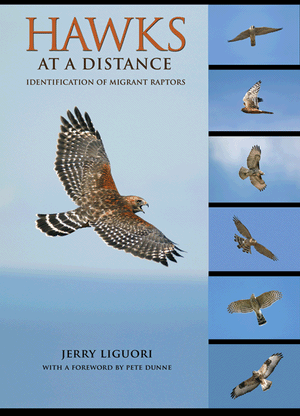
Book Review: Hawks at a Distance

Book Review time!
(required disclaimer:  Princeton graciously provided a copy for this review!)

Hawks at a Distance
By: Jerry Liguori
Price on the back cover: $19.95
~190 pages
~29 species


The Skinny: It's a superb book that teaches you to ID hawks from GISS (general impression size shape), and not just field marks, and it's only ~$20 so it's 100% a great buy. The extended version below:


Well the book starts off right with a spectacular topside shot of a Red-shouldered Hawk. Doesn't get much better than that, does it? I'm not sure what they've done in the printing process, but it really is spectacularly sharp... And just looks great... As a photographer, it doesn't start any better than this.

Breaking down the guide, it's organised as one would expect: 

Foreward
How to use the book
general AnatomyTips/hawkwatching etc
Species accounts
A fun section on "shapes" (more later) 
and credits/biblo


Sounds like a pretty generic field guide, right? Well, yes it sounds like it, but it isn't! 

Jerry is one of the best hawkwatchers ever. (Yes, ever). Hawkwatching is definitely one of the most unique/stand alone/different (couldn't choose a word) aspects of birding. (Don't believe me? Go to a hawkwatch and talk to the people who never even look at "dickey birds") ... Anyways... Jerry isn't one of those people, but is a master at the unique craft of hawkwatching... And now, in his two recent books (Hawks from every angle, and this one) he has done a great job in providing a teaching tool to pass along the things he's learned.

Hawkwatching often involves trying to identify migrant raptors passing a specific location at every height and behaviour. Sometimes, you'll have birds several kilometer's up, so they just appear as tiny spec's. Rather than use visual marks, sometimes you must rely on GISS (general impression size shape) and behavioural clues if you're going to have any hope of an ID! 

Anyways, before I ramble too much ... Have a look for yourself at some sample pages and you'll see where I'm goin with this:


Right away you can tell that they aren't frame-filling detail photos, and you're going to be learning about factor X of hawkwatching (I just made that name up). 

Now I'm sure some of you are saying "But Brandon, I don't want to identify hawks that are 8km's away".. And I'll say "but you don't have to!" Learning the skills provided in this book aren't only applicable to tiny microspecs, but will improve your ID of flying raptors in any situations. It's like going into battle with multiple weapons.. Or if you're the peaceful type (Hi Jenn!) It's like going to an ice cream shop that has several extra flavours. You'll just get better and better at getting those hawks. I might even stretch it far enough to say you'll then learn how to apply those skills to other families of birds on your own (I do it with fall warblers all the time). 


For ~$20 the book is absolutely a steal. Most of the specie accounts start off with a spectacular full frame photo, that is a recent trend in field guides I really like... The book ends off with a neat series of pages on "shapes" - focusing on each of the main species with dozens and dozens of small images. I won't go into too much detail (build suspense?) but you'll have to take a look for yourself if you see the book on the shelves! 


Who should buy it: if you spend time at hawkwatches, I'd say you MUST get it. If you are a "general birder", i'd still highly recommend it. 

Who shouldn't: buy it: Similar to my last review, I'd say this isn't a "first time" birder book. If you'd call yourself a "beginner birder", then yes, it's a good book. Just don't buy it for your young cousin who's never been birding in his life. 


Biggest concern: Although I love everything about the book, I wish there was a bit more attention to Mississippi Kites. Jerry did a neat thing here where he made a section in the last pages for "Uncommon Migrants and Others" - which is great - but I don't think Mississippi Kite should have been included here. It occurs in hawkwatches as far north as Duluth and Whitefish Point! (Along with most in Ontario/NY etc) .... It deserves more!


So there you have it..  Hawks at a Distance! Similar to last time, I'll update the post if there's anything else that comes to light after I publish this!


Sunday, July 3, 2011

Messed Up Mallards

Work gave me the chance to do some lazy birding yesterday. The locations I visited and some of the birds present:


Jarvis Sewage Lagoon: 1 Wood Duck and 10 Mallards

Townsend Sewage Lagoons: 5 Least Sandpipers, 2 Lesser Yellowlegs, Wilson's Phalarope, 3 American Wigeon, Redhead, ++ breeding Northern Shovellers and tiny baby Green-winged Teal!

Port Rowan Sewage Lagoons: 1 Ruddy Duck (only waterbird)

Big Creek (Long Point) : just stopped to enjoy the view. Sandhill Crane over the road.

Port Burwell Provincial Park: too many people... Some summering Bonaparte's Gulls, Great Black-backed Gulls.. Need to get back on a better day. Also had a Spot-winged Glider here.


Not much else to report but it was fun. My best butterfly was unfortunately run over (by me) -a very fresh Spicebush Swallowtail .


Other random stuff:


A fun bird story:

http://planetearth.nerc.ac.uk/news/story.aspx?id=983

and:


Some b-sides from my Newfoundland Trip: (sort of goes along with yesterdays crazy ducks)


Starting with, this hermaphrodite female mallard:


Study through your Mallards for long enough, and eventually you'll encounter an rather unfortunate lady Mallard like this.  I havent done any research in advance of this blog post, but what I understand generally happens is a female Mallard gets older and eventually starts producing enough male-hormones that her plumage starts to change. Some can end up having almost every single feather on their bodies plumaged like a male, but the give away is the black and orange bill of a female. 


I also decided to create a page for those odd domestic/cross/hybrid freakazoid mallards that we often encounter at our local duck park. They were everywhere in St. John's, and I ended up with some photos:


I'm still not 100% sure why I made the domestic mallard page, but maybe it's worth it.. They are decent photos... right? 


Saturday, July 2, 2011

Hybreed ducks!

For the first time since I started taking photos, I have ALL of my photos sorted into their proper places (with all the junk deleted).... First time EVER..

It's all a part of my plan to re-charge my rarity-finding batteries for fall migration, and I've really put the nose to the grindstone to get this done. Which also means, I've had some chances to edit said photos, and get them online. Today's collection (since I don't have any birding to talk about) is my hybrid duck photos:


I've added a "Hybrid/unusual" waterfowl section on the bird index page:
http://www.peregrineprints.com/ind__birds.htm

but anyways, here's the shots:


Mallard X Gadwall:

(also known as "Brewer's Duck"


(check out that wing pattern)

Mallard X Black Duck :
(not really exciting, but I had to do it)


Mallard X Pintail:

(oh those ducks)


Northern Pintail X White-cheeked Pintail:

This beast arrived at LaSalle Park in Burlington with a small flock (7 I think) of early migrant (wild) Northern Pintail... Where the heck did this duck come from? 


King X Common Eider: 

A throwback from the old nfld blog:


Ring-necked Duck X Scaup 

(ok, probably a RNDUxScaup crossed back with a scaup)


Bufflehead X Common Goldneye

Here with the parent species:


And a female Goldeneye X Hooded Merganser

(who woulda thunk it possible?)


Friday, July 1, 2011

Recent birdy things

Hybrid warbler from Oregon:

https://www.dropbox.com/gallery/24246065/1/Mystery_Bird_2?h=f33097#/

A recent topic of discussion on ID frontier's is this hybrid Warbler... Photographed a few days ago, it's a real looker. I get some Black-throated Blue and Canada warbler sort of feel from the bird, but it also wouldn't surprise me if it had some Macgillivray's Warbler in it.. It has some surprisingly similar features to the "Junkin's Warbler" in NY a few years ago:

The bird:

http://www.birds.cornell.edu/AllAboutBirds/mystery

more pictures:

http://www.birds.cornell.edu/AllAboutBirds/mysteryfiles/clues

the answer:

http://www.birds.cornell.edu/AllAboutBirds/mysteryfiles/answer/document_view


So it that bird has some Mourning in it, it wouldn't surprise me if the Oregon bird had some Macgillivray's.  But I guess we never REALLY know with these beasts.


There are some "known" hybrid warblers (Eg,/ Brewster's, Lawrence's, Sutton's) but it's really fun when these "unknown" hybrids are found/reported. A fun one from Michigan a few years ago is here:

http://www.amazilia.net/images/Birds/NewWarblers/Hybrid_Warbler.htm


And there's more out there online if you do some google'ing


--------------------

Rare shorebirds:

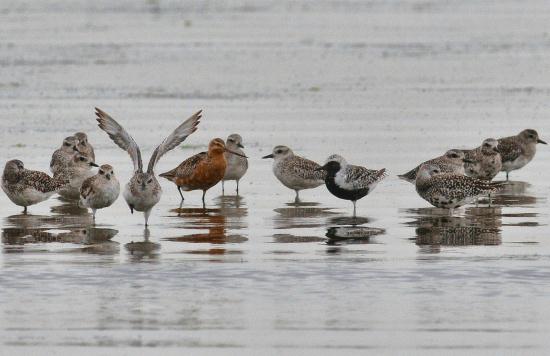
It might mainly be the pacific coast, but there always seems to be a pattern of mega-rare eurasian shorebirds occurring early in fall shorebird migration. I'll do more with this in a WHILE, but here's some fun photos:

Bar-tailed Godwit in BC:

http://www.surfbirds.com/media/gallery_photos/20110628113746.jpg


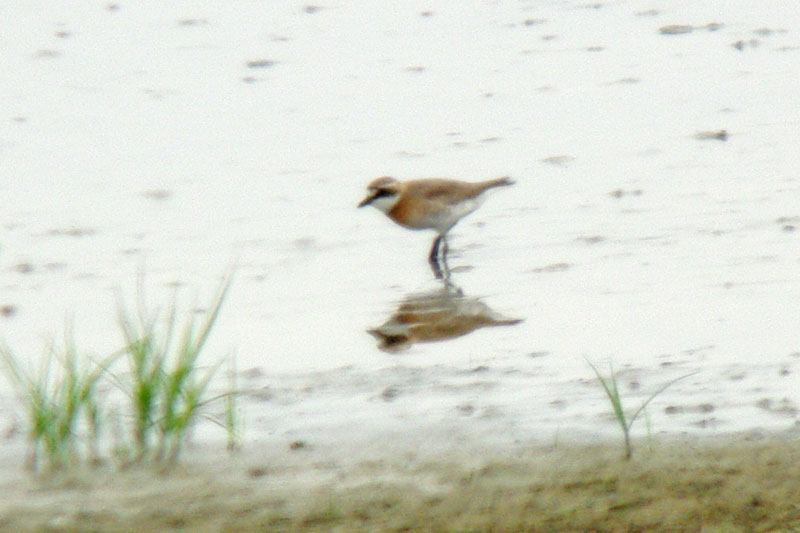
Lesser Sand Plover (Mongolian Plover) in California:

http://www.surfbirds.com/media/gallery_photos/20110626050329.jpg


Red-necked Stint in Texas:

http://www.kodakgallery.com/gallery/creativeapps/slideShow/Main.jsp?sourceId=533754321803&cm_mmc=Share-_-Personal-_-Email-_-Sharee-_-Top


---------------\

A few other rarity photos:

Little Egret, Maine: (I wonder if when/where Ontario could get this species)... James Bay might be a decent spot in my opinion. Too bad there's a few thousand KM's of great habitat no one is checking. ever.

http://www.flickr.com/photos/dhitchcox/5885974780/in/pool-437129@N20/


Dickcissels continue to be reported all over the states:

http://www.flickr.com/photos/tsirtalis/5882216489/in/pool-437129@N20/


--------------------

These "days" in Ontario birding history:

Green Violet Ear in Thunder Bay - June 30 - 1991

Baird's Sparrow - Rainy River - July 2, 1996

Yellow-nosed Albatross, July 4, 2010 (sad, sad memories)